Loading page
Product Updatespublished on
Introducing the LearnBook Learning Loop
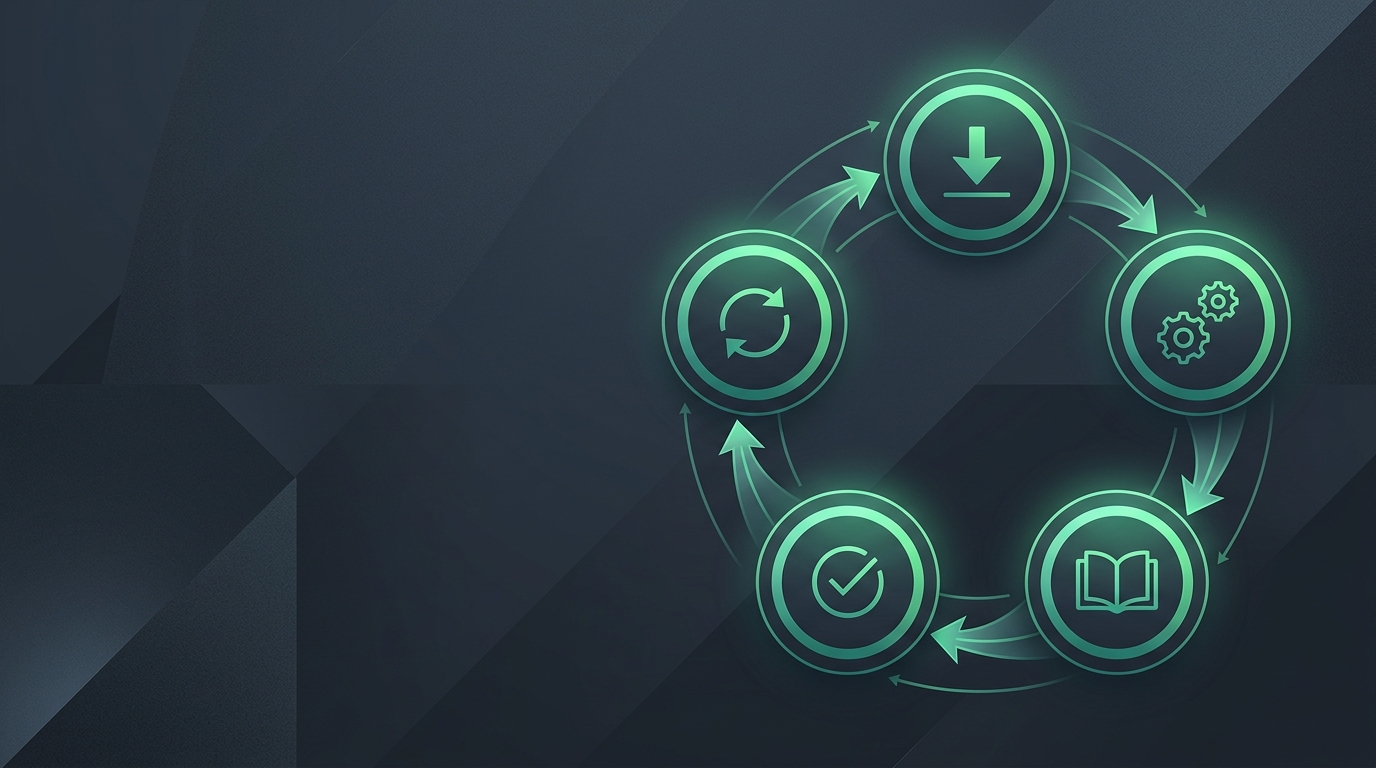
Most of us have experienced the same frustration: you read something thoroughly, feel like you understood it, and then a week later the details have vanished. The problem isn't your memory. It's that reading, by itself, is passive. LearnBook was built to change that. Its core is a five-stage Learning Loop designed to take any source material and turn it into something you can actually verify you have learned. This article and the updates that follow are part of our product updates series.
The Problem with Reading Alone
Reading gives you exposure. Exposure is not mastery. The gap between the two is where most self-directed learning breaks down. Summaries help you feel informed, but they don't tell you whether you can retrieve and apply the ideas on your own. LearnBook's Learning Loop addresses this gap directly: each stage builds on the last, and the whole system is oriented toward one goal — turning reading into verifiable learning.
Stage 1: Import — Bring In Any Source
The loop begins with what you already have. LearnBook accepts a wide range of source formats so you don't have to spend time converting or reformatting your material before you can study it.
- PDF files and EPUB books
- Web pages and articles
- Notes and Markdown documents
- YouTube video captions and lecture transcripts
- Podcast and audio files
- PowerPoint and presentation files
- Images with text (processed via OCR)
Whatever shape your learning material takes, it can enter the loop. See the full guide at importing any source into LearnBook.
Stage 2: Compile — Structure Your Material
Once imported, LearnBook compiles your source into a structured, studyable form — a personal book or course built from your own material. This isn't a flat transcript or a paste of raw text. The system extracts structure, surfaces key concepts, and prepares your content so it can be navigated, searched, and interrogated intelligently.
The tagline "Learn Anything to Book, by AI" comes from this stage. Any input — a cluttered research paper, a scattered set of notes, a long lecture recording — becomes a coherent, navigable document you can actually study.
Stage 3: Read & Ask — Active Reading with an AI Tutor
This is where passive reading ends and active engagement begins. As you read, you have access to an AI Tutor that answers questions grounded in your specific source material, with citations back to the relevant passages.
Ask about a concept you don't understand, and the tutor explains it using Socratic dialogue — leading you toward understanding rather than simply giving you the answer. Ask what something means in the context of a specific chapter or argument, and the response will reference that chapter directly. The AI Tutor is not a general chatbot; it is scoped to your material and accountable to it.
Every answer is grounded in what you imported. If it isn't in your sources, the tutor says so.
Learn more about how this works in the AI Tutor and active review guide.
Stage 4: Quiz & Flashcards — Test Yourself
Understanding in the moment is not the same as durable knowledge. Stage four moves from comprehension to retrieval. LearnBook automatically generates flashcards and quizzes from your compiled material, each one cited back to its source so you know exactly where a concept came from.
Flashcards surface key definitions, terms, and ideas. Quizzes test your ability to apply and connect them. Because both are derived from your own material — not generic question banks — they reflect exactly what you are trying to learn. Testing yourself actively encodes the material in a way that re-reading cannot.
Stage 5: Review — Close the Loop with Spaced Repetition
The final stage is what transforms a one-time study session into lasting retention. LearnBook schedules your flashcard and quiz reviews using FSRS, a modern spaced-repetition algorithm that predicts when you are most likely to forget each item and surfaces it just in time.
Reviews are not siloed to a single book. The cross-book review system pulls from everything you have studied, connecting ideas across different sources as your knowledge base grows. Mastery trends let you see which topics are solidifying and which still need attention. The 21-day memory loop reinforces material at the intervals that matter most for long-term recall.
Study streaks and an XP and level system keep momentum going. Team leaderboards, quiz challenges, and friend head-to-head (PK) competitions make the loop social when you want it to be.
For a deeper explanation of how the scheduling algorithm works, see how FSRS works.
Why the Loop Matters
Each stage has value on its own, but the power is in the sequence. Importing without structure leaves you with a pile of text. Compiling without asking questions keeps you passive. Reading without testing leaves you with a false sense of mastery. Testing without review lets the knowledge decay. Review without good scheduling is busywork.
When the stages work together, something different happens: you can actually verify what you have learned. Not because LearnBook tells you so, but because you can retrieve it, apply it, and explain it — even weeks later.
That is what "turning reading into verifiable learning" means in practice.
If you have a book, paper, lecture, or set of notes you have been meaning to truly learn — not just skim — bring it into LearnBook and run it through the loop. The difference becomes clear quickly.
Share
Related Posts
Product Updates
A roundup of recent LearnBook updates: FSRS-scheduled reviews, cross-book recall, mastery trends, and the 21-day memory loop.
2026-06-18T14:12:45+08:00