Loading page
Learning Sciencepublished on
The Forgetting Curve: Why You Forget and How to Stop It
Most people study something, feel like they understood it, and then discover days later that large portions have simply vanished. This isn't a personal failure — it is a predictable biological process that Hermann Ebbinghaus mapped in meticulous detail over a century ago, and one that modern memory science has shown we can directly counteract.
Ebbinghaus and the Shape of Forgetting
In the 1880s, the German psychologist Hermann Ebbinghaus conducted a now-famous series of self-experiments. He memorized long lists of nonsense syllables and then tested his own retention at carefully measured intervals — hours, days, weeks later. What he discovered was not a smooth, gradual fade but a steep initial drop followed by a much slower decline.
He plotted this as a mathematical curve. The core finding: without any review, a person forgets a dramatic proportion of newly learned material within the first day. After that, the rate of loss slows, but the damage is largely done. By the end of the first week, most of what was passively learned has become inaccessible without significant effort to reconstruct it.
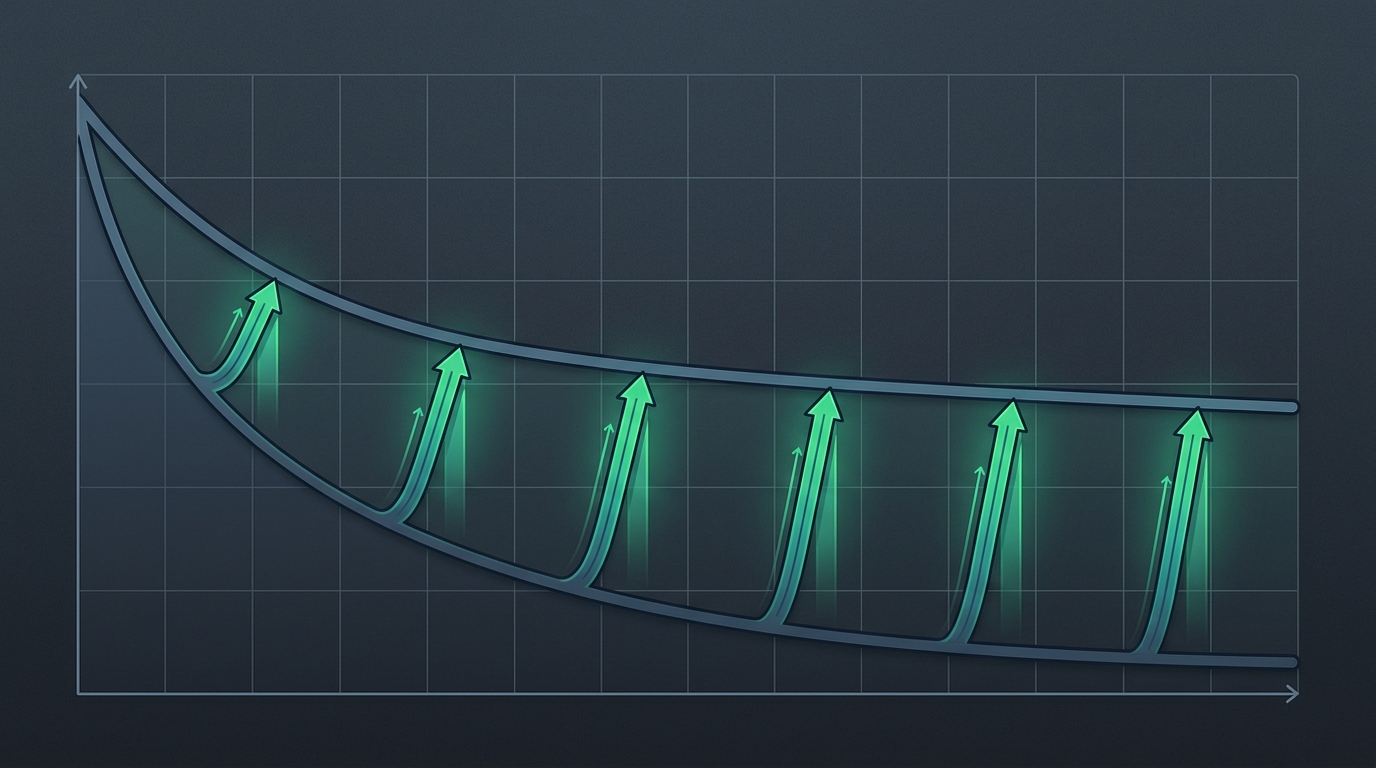
Ebbinghaus found that forgetting is rapid at first and then levels off — most loss happens within the first days, after which the remaining memory decays much more slowly.
The curve is not an absolute — it shifts depending on how meaningful the material is, how deeply it was processed, and how many times it has already been reviewed. But the underlying shape holds across learners, subjects, and contexts. The forgetting curve is one of the most replicated findings in memory research, first documented by Ebbinghaus in the 1880s.
Why Memory Decays: The Consolidation Gap
Memory is not stored like a file on a hard drive. When you learn something new, neurons form temporary connections. For those connections to become stable long-term memories, the brain must go through a consolidation process — often during sleep, and through repeated activation of the same neural pathways.
Passive re-reading or highlighting does almost nothing to trigger this consolidation. The brain takes the path of least resistance: if information is always available (the book is open, the notes are in front of you), there is no signal that it needs to be retained. The brain essentially decides it does not need to invest energy in storing what can always be looked up.
This is why the subjective feeling of understanding during a lecture or a reading session is such an unreliable indicator of what you will actually be able to recall later. Familiarity and retrievability are different things.
The Spacing Effect: Reviewing at the Right Moments
Ebbinghaus also discovered the antidote embedded in his own data. He found that the timing of review mattered enormously. Reviewing material just before it would otherwise be forgotten was far more efficient than reviewing it immediately after learning or waiting until it was almost completely gone.
This is the spacing effect: distributing practice across time produces substantially better long-term retention than cramming the same total amount of study into a single session. The spacing effect has been replicated so many times across so many different types of material — vocabulary, concepts, procedures, facts — that it is among the most robust findings in cognitive psychology. For a practical guide to all the techniques that exploit it, visit our learning science collection.
| Study Strategy | Short-term Performance | Long-term Retention |
|---|---|---|
| Massed practice (cramming) | High immediately after | Poor — rapid decay resumes |
| Evenly spaced review | Moderate | Good |
| Optimally timed spaced review | May feel harder during study | Excellent — curve flattens significantly |
Active Recall: The Other Half of the Equation
Spacing alone is powerful, but it works best when combined with active recall — actually retrieving the information from memory rather than passively re-exposing yourself to it. Every time you successfully retrieve a memory, the neural pathway is strengthened. Every successful retrieval also resets the forgetting curve for that piece of information, pushing the next required review further into the future.
This is why flashcards, practice tests, and the "blank page" method (writing down everything you remember about a topic without looking at your notes) are so much more effective than re-reading. See also: Active Recall Guide for a full breakdown of how to apply these techniques.
The practical implication is significant: a short, active review session — five minutes of testing yourself on material — can do more to flatten the forgetting curve than thirty minutes of passive re-reading.
Flattening the Curve: What This Looks Like in Practice
When spacing and active recall are combined systematically, the forgetting curve flattens over successive reviews. The first review might happen after a day; the second after three days; the third after a week; and subsequent reviews stretch out to months and eventually years. Each successful retrieval consolidates the memory further.
The material does not disappear from the curve entirely — that is not how human memory works. But the slope of decay becomes so gradual, and the spacing intervals so long, that the information effectively becomes part of long-term memory. Researchers sometimes describe this as moving from "fragile" to "durable" memory traces.
Common Mistakes That Keep the Curve Steep
- Reviewing too soon: Going over material within minutes of learning it provides very little consolidation benefit. The gap needs to be long enough that some forgetting has begun.
- Passive re-reading as the primary strategy: Re-reading creates a feeling of fluency (the material feels familiar) without actually strengthening retrievability.
- Irregular intervals: Spacing that is too short wastes time; spacing that is too long means you are re-learning rather than reviewing. The efficiency comes from hitting the right window.
- Ignoring individual difficulty: Different pieces of material have different forgetting rates for different people. A one-size-fits-all review schedule is a rough approximation at best.
Spaced Repetition Systems: Automating the Optimal Schedule
Modern spaced repetition systems take the spacing effect and make it practical. The algorithms behind them — particularly how FSRS works — go far beyond simple fixed schedules. Rather than requiring you to manually track what needs to be reviewed and when, these systems maintain a model of your memory for each individual item and schedule reviews at statistically optimal intervals. The harder an item is for you, the more frequently it appears; items you know solidly get pushed further and further into the future.
The underlying algorithms — including FSRS, the current state of the art — are trained on large bodies of real review data to predict, with remarkable accuracy, when a specific item is likely to drop below a target retention threshold for a specific person. This is not a rough heuristic; it is a continuously updated model of your memory.
The Key Insight
Forgetting is not a problem with your intelligence or your dedication. It is the default behavior of a biological system that discards information it has no reason to keep. The forgetting curve shows exactly how that process unfolds — and, crucially, it shows exactly where to intervene. Review at the right moment, retrieve actively rather than passively, and the curve that once worked against you starts working for you.
Upload a single PDF to LearnBook and it becomes a set of cited flashcards on an FSRS schedule — your first review lands at the moment the forgetting curve would otherwise have already done its damage.
Share
Related Posts

Learning Science
Working memory is limited. Cognitive load theory explains how to structure material so you learn faster without overwhelming it.
2026-06-18T14:12:45+08:00

Learning Science
Testing yourself isn't just measurement — the act of recalling strengthens memory. A practical guide to retrieval practice and why it beats rereading.
2026-06-18T14:12:45+08:00