Loading page
Study Methods & Active Recallpublished on
The Feynman Technique: Learn Anything by Teaching It
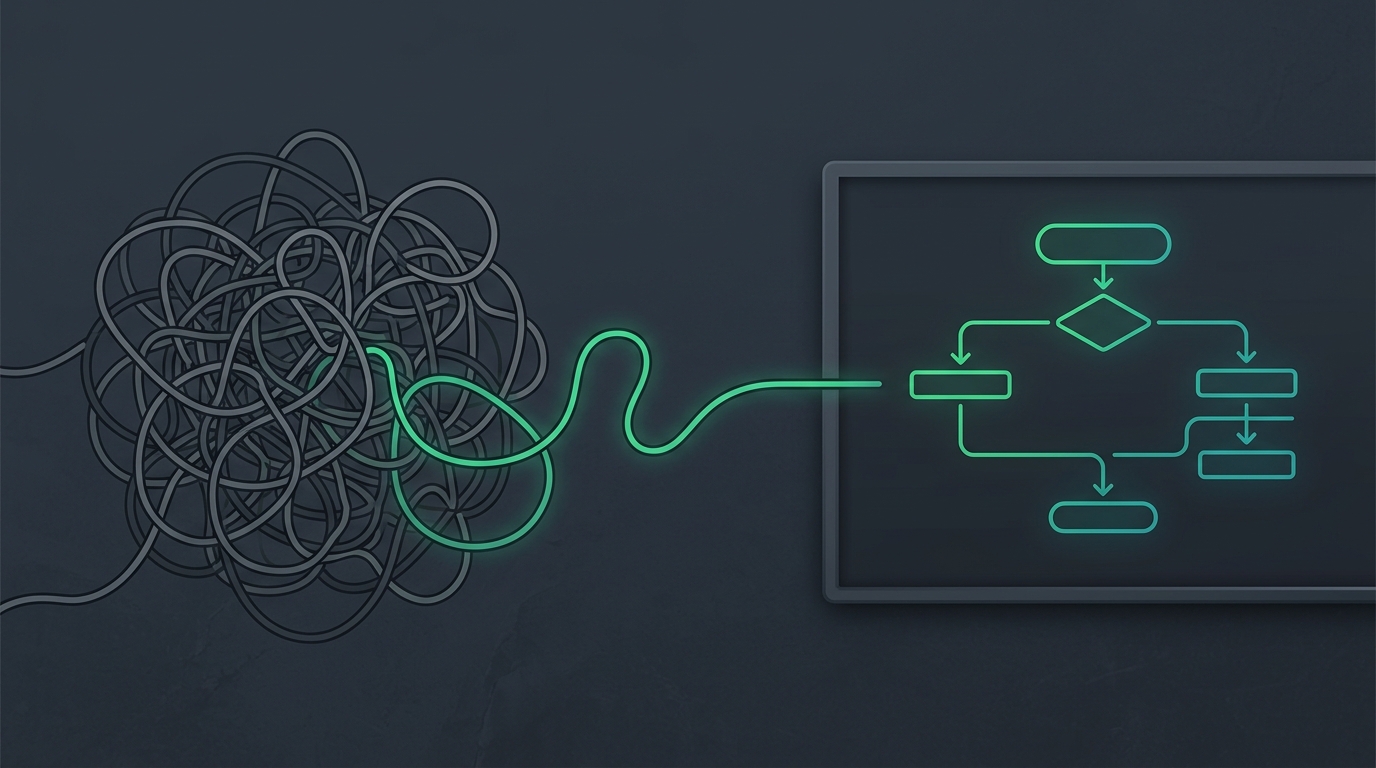
There is a particular kind of confusion that only surfaces when you try to explain something. You have read the chapter, reviewed the slides, and feel reasonably confident in the material — until someone asks you to walk them through it. Suddenly the explanation stalls, the logic breaks down, and the gaps between what you thought you understood and what you can actually articulate become impossible to ignore. The Feynman Technique turns this discomfort into a systematic study method by using explanation as a diagnostic tool. It is one of the most powerful techniques in the study methods repertoire.
The Four Steps
Step 1: Choose a Concept and Write It Down
Pick a single concept you are trying to learn — not a chapter, not a broad topic, but a specific idea. Write the concept name at the top of a blank page. The constraint of specificity matters: "quantum mechanics" is too large; "why electrons occupy discrete energy levels" is workable. You are about to try to teach this concept, and a bounded scope makes it possible to detect exactly where your understanding ends.
Step 2: Explain It As If Teaching a Newcomer
Write out an explanation of the concept in plain language, as if you are teaching someone who has no prior knowledge of the subject. Do not use the textbook. Do not consult your notes while writing. Use your own words — the simpler the better. Avoid jargon unless you can also explain what the jargon means. If you find yourself writing a term without being able to unpack it, that term marks a gap.
The target audience for your explanation is often described as a child or a curious non-specialist. This is not about being condescending — it is about removing the scaffolding of technical vocabulary that can give the impression of understanding without providing it. If you cannot explain something simply, you do not yet understand it deeply enough.
Step 3: Identify the Gaps and Return to the Source
Review what you wrote. Every place where your explanation became vague, relied on undefined terms, skipped a logical step, or simply stalled — those are your knowledge gaps. Write them down explicitly. Then go back to the source material, your textbook, your notes, or the primary text, and study specifically those gaps. Do not re-read everything; focus on what your explanation revealed you do not actually know.
This step transforms passive re-reading into targeted repair. You are not reviewing for general familiarity — you are returning to the source with a specific list of deficiencies to resolve. This is more efficient and substantially more honest than general revision.
Step 4: Simplify and Use Analogies
Once you have filled the gaps, rewrite the explanation. This time, look for analogies — comparisons to things the hypothetical newcomer already understands. A good analogy does not need to be perfect; it needs to convey the structure of the relationship or process you are explaining. The effort of finding an analogy is itself a test: if you cannot find one, your understanding of the mechanism may be more superficial than you realised.
Repeat this cycle — explain, identify gaps, study, simplify — until your explanation is clear, complete, and free of undefined terms. The endpoint is an explanation that a thoughtful person with no background could follow.
Why Explanation Exposes Illusions of Understanding
Reading and listening are primarily recognition tasks. You encounter an explanation, it seems coherent, and you register it as understood. But recognition is not the same as the ability to reconstruct or apply. The difference only becomes visible under the pressure of output.
When you write an explanation, you must:
- Sequence steps and ideas in a logical order
- Specify cause-and-effect relationships rather than leaving them implicit
- Define every term you use, or acknowledge you cannot
- Connect the concept to related ideas you already understand
- Account for why the concept behaves the way it does, not just describe that it does
Each of these demands exposes a different species of shallow understanding. The Feynman Technique is effective precisely because it makes these demands simultaneously and immediately, rather than waiting for an exam to reveal the shortfall.
If you cannot explain it simply, you do not understand it well enough yet. The gap between what you can recognise and what you can reconstruct is where the real work of learning happens.
A Worked Example
Suppose you are studying opportunity cost in economics. Your first explanation attempt might read: "Opportunity cost is what you give up when you make a choice."
This is a start, but an explanation like this stalls immediately under scrutiny. What does "give up" mean precisely? Are we talking about money, time, or something else? Does it refer to the best alternative or all alternatives? You have described the idea without actually explaining it.
After identifying these gaps and returning to the source, you might revise: "Opportunity cost is the value of the single best alternative you did not choose. If you have an afternoon free and you choose to study, the opportunity cost is not the sum of everything else you could have done — it is the value of the one best thing you chose not to do, whether that was working a shift, resting, or seeing a friend. It is invisible in the decision but real in the outcome."
Now add an analogy: "It is like every door you open meaning another door stays closed. The cost is not all the closed doors — just the most valuable one."
The revision is more specific, more mechanistically honest, and more memorable. The analogy is imperfect — analogies always are — but it conveys the structure of the concept in terms a newcomer can hold.
Applying the Feynman Technique to Reading
The technique integrates naturally into active recall reading practice. Rather than simply recalling facts after reading a section, you attempt to explain the concept from the section — its mechanism, its implications, and why it matters — before checking your explanation against the source.
A practical approach for reading-based study:
- Read a section or chapter with the goal of understanding, not memorising.
- Close the book and write a plain-language explanation of the central concept or argument.
- Reopen the book and compare your explanation to the source. Mark gaps.
- Study the gaps specifically. Write a revised explanation.
- Distil the concept into a single sentence or analogy you could say aloud in under thirty seconds.
This approach works on any subject where conceptual understanding matters — mathematics, science, history, philosophy, law, economics. It is less suited to pure memorisation tasks like vocabulary lists or dates, where the goal is retention rather than comprehension. For those, spaced repetition and structured flashcard practice are more efficient.
Common Mistakes
- Explaining to yourself while looking at the source: This is transcription, not explanation. The source must be closed before you write. The difficulty of writing without it is exactly the diagnostic value of the technique.
- Accepting vague language: Phrases like "it kind of works like" or "it has something to do with" are signals to stop and diagnose, not to continue writing. Vagueness is not a rhetorical problem — it is a knowledge problem.
- Skipping the analogy step: Analogies feel optional but they are not. The pressure to find an analogy forces you to identify the structural essence of a concept rather than its surface features.
- Treating one cycle as sufficient: For complex concepts, a single pass through the four steps will not produce a complete explanation. Expect to cycle through the steps two or three times, each pass resolving a finer layer of gaps.
- Applying it to everything simultaneously: The technique is powerful but slow. It is best used on the core concepts in a subject — the ideas that other things depend on — rather than applied indiscriminately to every fact.
The Connection to Deeper Learning
The Feynman Technique is not primarily a memorisation strategy — it is a comprehension strategy. Its goal is to move from surface familiarity to genuine structural understanding: knowing why something works, not just that it does; being able to reconstruct reasoning, not just recognise it. This kind of understanding is more durable, more transferable, and more useful under exam conditions than memorised summaries. It also transfers more reliably to new learning, because well-understood concepts form stable anchors to which new information can be connected.
LearnBook imports your reading material and generates flashcards and quiz questions automatically, then schedules your reviews — so you can apply the Feynman loop at the concept level and let the platform handle the scheduling of when to revisit each idea as your understanding develops.
Share
Related Posts

Study Methods & Active Recall
Studying one topic to exhaustion feels productive but interleaving — mixing related topics — leads to better long-term learning.
2026-06-18T14:12:45+08:00

Study Methods & Active Recall
Active recall means retrieving answers from memory instead of rereading. A practical guide to using it in any subject.
2026-06-18T14:12:45+08:00